Spotlight On: Supriya Nagarajan

West Yorkshire is home to an incredible array of talent - both on and off the stage! We wanted to shine a Spotlight On some of the amazing people working in our region. If you have someone you would like to feature (self-nominations welcome) please contact: westyorkshiremusicnetwork@gmail.com
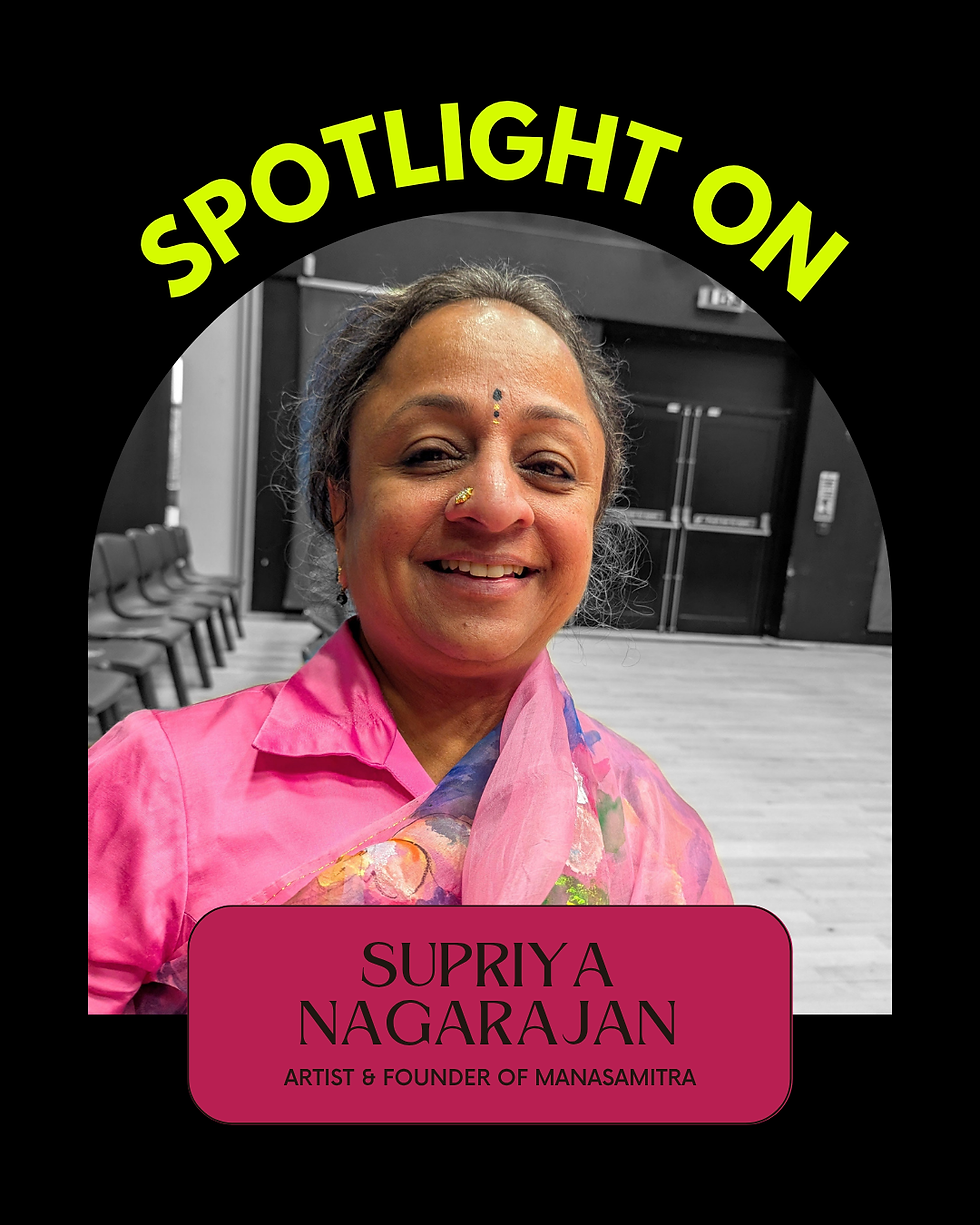
Who are you and what do you do?
I am a musician, composer and vocalist. I learned South Indian classical music, but I use my music in different cross-cultural collaborations, and I work with a wide range of artists from different traditions. I think that's the key part of what I enjoy about my music, is that I'm not in any one box. I'm like traveling around and exploring and being curious, and so I enjoy the journey as much as the end music that we make. So that's in a nutshell, who I am, and I compose music in precisely the same manner. So I like to explore and devise everything you know in a in a novel, sort of unique way.
Are there any projects or initiatives in your career that you are most proud of?
I think each of my projects has been lovingly crafted. If the concept appears, and I properly, thoroughly investigated, and find the collaborators who will actually advise me (it could be university professors, or it could be somebody with a specialism in that kind of work or my peers) then I create the work. So, everything is very precious to me. The particular work if I have to single one out, then I think would be Lullaby: Sonic Cradle. This work really talks to me because it's been touring 10 years, and it's still very much in demand. We are doing it at the Saltburn Folk Festival on Sunday, which means the life of the Lullaby is so extended because it's so open and flexible and collaborative. So, I could work with any artist around the around the globe with their practice. That particular project really appeals, because in this world of so much noise, I’m able to create that one hour of utter peace and relaxation, where people can actually bring a cushion and lie down and listen to the show without the pressure of having to be in any certain way. It also has mixed audiences: it could have had a 10-day old infant to 100-year-old grandmother in the audience. That is the beauty of the show. It is you. Is so gentle and soothing and it lives up to its name. So for me, that show, and the fact that I've collected, with people's help, over 800 lullabies - that feels like my flagship sort of project, which is still continuing.
What you think the biggest challenges are that we’re facing today, and how we can address them?
I can speak from the point of view of Kirklees, where I'm based. I think Kirklees has had its fair share of festivals and open events where musicians could get a foot into the door and get going. But there hasn't been a sustained effort, and there isn't that mechanism which has a continuous, sort of developmental ladder that people can climb onto and then keep climbing. It's like, after certain point, you have to fend for yourself. I guess that is probably true of the wider West Yorkshire area as well. We need a mechanism from which there is an entry point. There is a definitive pathway. I know each musician and each discipline comes with different challenges, but then, it would be great to see a prescribed pathway where people can actually look up to role models, have some mentoring, and do the things that they really want to do, that’s not all funding based. Funding is, of course, a main consideration, but it's not all funding based. It could be just a case of somebody directing them down a pathway and carving something for themselves. Gone are the days when somebody is going to spot you and you're going to become this big name. That that kind of a day is now gone with social media being so prolific. So, you need a pathway to actually go. I think the West Yorkshire Music Network might be best placed to actually create and carve that pathway for music and musicians in this in this area, and I think that, that pathway is probably what is first required for music to actually flourish here. Then following that, of course, there are going to be few fallouts, and few people are going to become this big new sensation, and that will be really good. They at least know that they have made all the things possible that they could possibly do in their career, and then they either flourish or they are not able to cope. And that's fine. They know they have done it, and I suppose, from our point of view, somebody like me who's been in this for 20 years, it'll be lovely for me to mentor people into this pathway and see them flourish.
How important, or how do you think we can, as a local community, get more involved with shaping the future of music?
I think what is really important is that grassroots venues should encourage local talent alongside big names. I know that many festivals have this combined issue of, how do you promote the festival without having some headline acts there? But then, if you are importing headline acts from different parts of the world or different parts of the country, then there is an obligatory duty to actually get the headliner to recognise and work with some local talent. So, the need for education and mentoring side-by-side with letting grassroot venues or festivals or similar flourish. I think this is an important aspect, and I think that's sometimes missed, because for example, if you're getting an artist from America, and they then perform to a full house - then they leave, and what happens to the local artists? What happens to the local audience? Maybe even as young as the schools in the area, there has to be an obligation on the part of the grassroots venue and festivals to actually dig deep and find the budgets to support these groups to actually one be exposed to and to be directed by the success of the headline acts. So, I think that is a starting point. So, if the grassroots want to make one change, I think it is to actually program local talent along with somebody who is really popular, so that they then have the ability to be exposed and have the chance to prove their own talent as well. So, I think that's the first step. And then there are so many other things, but you have to start somewhere!
How do you believe that we can better support emerging talent working in genres or underrepresented areas?
For me personally, my genre has never been something that's placed and has kept me in a box. I've always collaborated outside the genre and have seen how I can take the genre into a space that has not been explored before. Most of my collaborations have been with quirky projects, and concepts out of the box. I started my career with Yorkshire Sculpture Park, which is not a music venue. I started to work with responses to sculptors. So, I used my music to actually respond to the work of Andy Goldsworthy and Jaume Plensa, and people like that. There were concerts held, which actually was my response to their work, almost cross-disciplinary. I think that is the avenue that one should look for. Because if somebody stays in their box of genre, then what happens is they only find the audience that likes that genre, and therefore they have no opportunity to build their audience numbers, because in a certain area, you are therefore restricted to the same people that usually like your work. It's okay, but after a point in time, it becomes too small for you to actually sustain your career. So, I always looked for opportunities to create new audiences, and that's where it came from. My cross-disciplinary, cross cultural kind of collaborations, I think is what that should be encouraged. Because if a hip hop artist, for example, wants to work with a Carnatic vocalist like me, for example, it is not something that would naturally occur. Then if that kind of fund exists where cross disciplinary or cross-cultural collaborations are targeted and people are encouraged to actually work on that, then you have the opportunity to create something. I actually sing pure Carnatic music in all my collaborations, and any part of the world can correspond and work with me. I work with sound artist Duncan Chapman, and he brings world sounds to the mix, and world sounds merges with Carnatic music to create a confluence that is unique, but something that audiences enjoy. We have worked in different settings with different collaborators and trios. It was even once an ensemble of nine from different parts of the world: a Colombian harpist, French horn player from Finland, Duncan and myself. We had a kantele player from Finland, and a guitarist from Colombia. You know when you say music is a has a universal language- it is true. I think every talented musician brings that to the table, and it's just having the courage to explore. If anything, any one thing I would suggest is having a dedicated fund, maybe the Arts Council, maybe the local West Yorkshire combined authorities, but having something dedicated to encourage that, which then means that it opens opportunities and doors for the musicians of a particular genre who want to explore.
What is your vision for the music sector in West Yorkshire?
I am hoping that there will be confluence of all the movers and shakers in the area coming together to create a pathway like I mentioned before. So, it could be the universities, the colleges, the conservatoires, the music bodies, and Arts Council. Any funders coming together to create a pathway where somebody coming, say, straight out of school, could then decide, “I want to do this”, almost like an apprenticeship. They need to know that at the end of whatever they are doing, they can actually make a living and pay a mortgage. As we know, the cost of living is rising. So, they need to know that end of this, they have something viable. Then also this pathway of promoting music in all its dimensions could be that you are providing music to ads and films and games. You are providing music to documentaries. You are doing live performances, because music is seen by different people as mono-dimensional, in a way, because they don't visualise the entire range of what is possible, and installation performances. So, what I think this pathway at some point should have this exposure to what is possible with music. I think what will be very valuable is as a first step, bringing all the movers and shakers together and getting them to talk to each other, and having everybody in the room such that that body can then lobby people with money. It could be the corporates, it could be the businesses, it could be the rich donors, but that body will be in a good position to lobby, I think that's the first step. Everybody talking to each other, and getting the ability to be a unified voice, and then from there on, anything is possible.
You can find out more about Supriya via Manasamitra or follow on Instagram: @manasamitrauk
Image © Dr Srinivasan Nagarajan

